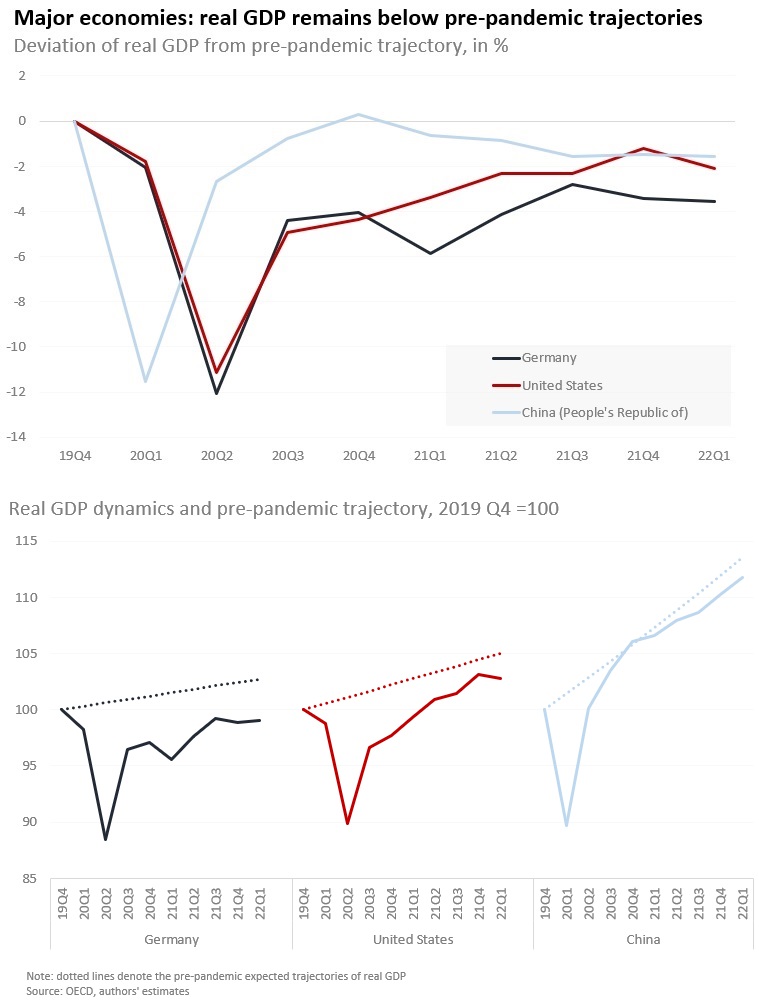

Pattern of post-pandemic economic recovery has been very different in US, China, and Germany.
Post-pandemic performance of German economy was very week, being substantially hampered by successive pandemic waves and by large disruptions in global value-added chains. Germany is the clear laggard among the three countries in terms of economic recovery. The real GDP level from Q1 2022 in Germany was still 0.9% below its pre-pandemic level from Q4 2019, while being 3.6% below the pre-pandemic expected trajectory (extrapolated from Q4 2019 using an annual growth rate of 1.2%).
China was the frontrunner of post-pandemic economic recovery. China’s economy showed the fastest recovery in 2020 as first COVID-19 lockdown was short-live and global demand for China’s exports boomed. So, in Q4 2021 China’s economy already returned to its pre-pandemic expected trajectory (extrapolated using an annual growth rate of 5.8%). Still, new pandemic waves and bottlenecks in global value-added chains limited the GDP advance in 2021 to only 4.0% (so, much below the pre-pandemic expected economic growth of 5.8%). As of Q1 2022, real GDP in China was still 1.6% below its pre-pandemic expected trajectory, although it outpaced the level from Q4 2019 by 11.7%.
In US, economic recovery was delayed in 2020, but got strong traction in 2021, benefitting also from a large support from very stimulative policies of government and of central bank. So, real GDP advance totaled 5.5% over the four quarters of 2021. As of Q1 2022, real GDP was 2.1% below its pre-pandemic expected trajectory (extrapolated from Q4 2019 using an annual growth rate of 2.2%).
The shortfall of US real GDP against the pre-pandemic trajectory observed during Q4 2021-Q1 2022 was close to that observed for China’s real GDP. This means that the stage of economic recovery is now similar in these two economies. Still, one should have in mind that cumulative GDP losses of US economy during 2020 and 2021 were much larger that those recorded in China.