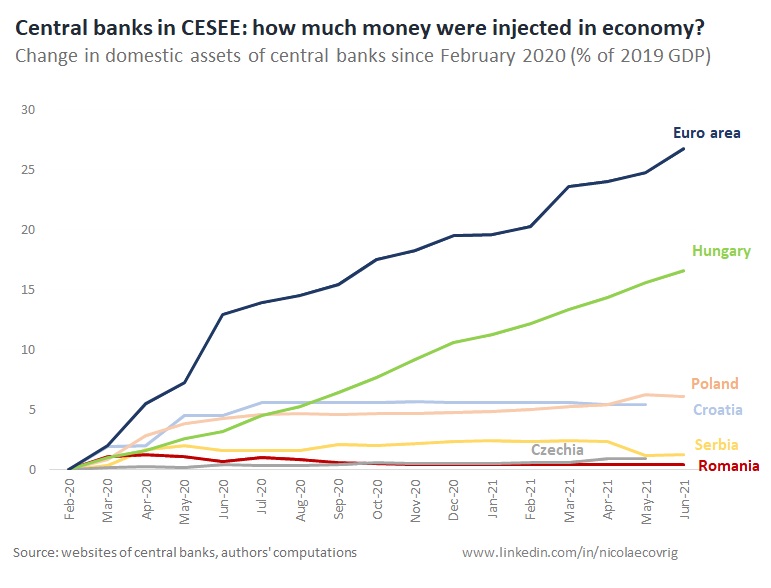

Besides reducing the interest rates, central banks in the Central and Southeastern Europe stepped in to fight the adverse effects of pandemic (1) by purchasing government securities and (2) by lending money to the banks and economy.
The largest support to the economy was provided by the Hungarian Central Bank which domestic assets increased by 16.6% of the 2019 GDP since February 2020. Central banks in Poland and Croatia followed with an increase in their domestic assets by around 6.1% of GDP and 5.4% of GDP respectively.
Quantitative easing operations was substantially more limited in volume in Serbia and Romania, while central bank in Czechia remained on the sideline.